Betta burdigala
Betta burdigala
(75-82°F)
Care Requirements
💧 Water Parameters
🏠 Tank Setup
🍽️ Diet & Feeding
In captivity it accepts small live and frozen foods such as daphnia, mosquito larvae, and brine shrimp, along with high-quality micro-pellets designed for carnivorous fish.
🐟 Community Compatibility
Best kept alone or with very small, peaceful, non-fin-nipping tankmates due to its shy and territorial nature.
⚥ Sexual Dimorphism
Males are more intensely colored and develop slightly longer, more pronounced fins than the comparatively duller, shorter-finned females.
🌍 Origin
Southeast Asia
About Betta burdigala
Think of a wine-red ember slipping through tea-black water, and you’re already close to Betta burdigala.
This diminutive betta hails from the shadowed peat-swamp forests of western Indonesia, where fallen leaves stain streams the color of strong tea and the canopy keeps sunlight to a hush. Like all labyrinth fishes, it carries a specialized organ that lets it gulp atmospheric air, a key adaptation in oxygen-poor backwaters that would challenge most other fish.
Betta burdigala belongs to the coccina complex, a cluster of small, red bettas whose differences are subtle and best appreciated up close: shifts in fin shape, the way a stripe starts or ends, the sheen that flashes on the gill cover. In life, B. burdigala’s palette earns double-takes—deep Bordeaux reds edged in smoke, often with a quiet metallic glint that appears and vanishes as the fish tilts in the gloom.
It’s a fish made for leaf litter. In its native streams, layers of decomposing leaves create a maze of hideouts and microhabitats, and B. burdigala threads through them, hugging cover and ambushing tiny invertebrates. Social encounters are a choreography of flares and feints, with males intensifying in color during courtship; as in many bettas, the male takes on the parental role after spawning.
The species’ name is a story in itself. “Burdigala” is the ancient name for Bordeaux, a connection many enthusiasts read as a nod to the fish’s wine-red hue, and you’ll sometimes hear it nicknamed the Bordeaux betta. It’s a reminder that taxonomy can be as poetic as it is precise.
If you’re used to the bombast of Betta splendens, B. burdigala feels like a quiet counterpoint—smaller, more secretive, and evolved for a world of dim light, extreme softness, and acidity. These peat swamps are biodiversity hotbeds, but also among Southeast Asia’s most threatened habitats due to drainage, fire, and conversion; when you look at B. burdigala, you’re seeing both evolutionary finesse and ecological fragility.
Field notes from researchers and hobbyists often mention how this fish seems to “switch on” under subdued lighting, when the reds deepen and the iridescence wakes up. It’s one of those species that rewards unhurried watching: pause long enough, and you’ll catch the moment the forest floor comes alive, one wine-colored flicker at a time.
Ready to Add Betta burdigala to Your Tank?
Use our free stocking calculator to see if Betta burdigala fits your aquarium setup!
Try the Stocking CalculatorKeep Your Betta burdigala Happy with Fishi
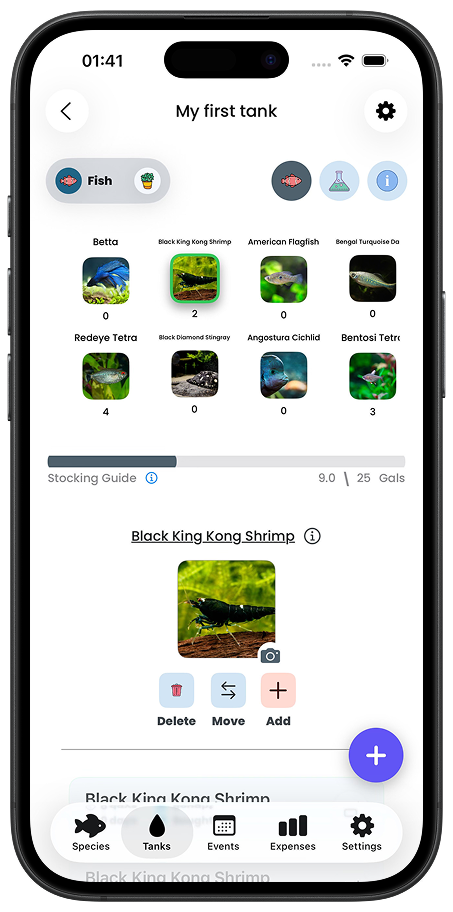
Track your aquarium's health and ensure your Betta burdigala is thriving with the Fishi mobile app!
- ✓ Monitor water parameters for optimal Betta burdigala health
- ✓ Get reminders for water changes and maintenance
- ✓ Track feeding schedules
- ✓ Log tank observations and fish behavior
- ✓ Manage multiple tanks effortlessly


Loved by over 100,000 fishkeepers