Betta coccina
Betta coccina
(76-82°F)
Care Requirements
💧 Water Parameters
🏠 Tank Setup
🍽️ Diet & Feeding
In the wild it likely feeds on small aquatic invertebrates and insect larvae, but in captivity it accepts high-quality flakes, micro-pellets, frozen or live foods such as daphnia and bloodworms.
🐟 Community Compatibility
Best kept either alone or with very peaceful, non‑nippy, similarly sized tankmates that will not outcompete it for food.
⚥ Sexual Dimorphism
Males are more intensely colored with longer, more developed fins and a distinct blue-green lateral iridescent spot, while females are duller with shorter fins.
🌍 Origin
Southeast Asia
About Betta coccina
A flash of scarlet flickers through water the color of strong tea—that’s Betta coccina in its element.
Often called the scarlet betta, Betta coccina is a tiny wild betta native to the peat-swamp forests of Sumatra and the nearby Riau Archipelago in Indonesia. These are dim, quiet waters stained by tannins from layers of fallen leaves and branches, with soft, acidic conditions and an intricate maze of roots where miniature predators and prey constantly negotiate the shadows.
Its name literally means “scarlet,” a nod to the glowing red body that sets it apart. Described by the 19th‑century Dutch ichthyologist Pieter Bleeker, B. coccina later lent its name to the broader “coccina group” of small, red, blackwater bettas—an assemblage that has kept taxonomists busy as look‑alike local forms continue to reveal hidden diversity.
Life in peat swamps is low‑oxygen and low‑light, so B. coccina comes equipped with a labyrinth organ that lets it breathe air at the surface and thrive where many fishes cannot. In the leaf litter it moves with a furtive confidence, its metallic highlights catching just enough light to signal to other fish without broadcasting its location to predators.
Though small, it’s bold in personality. Males intensify to a deep ruby during displays, flaring fins and gill covers in tight, choreographed bouts that resolve territory and courtship with surprising subtlety. As in many bettas, the male takes on parenting duties, a strategy that helps ensure offspring survive in these fragile, patchy habitats.
Peat‑swamp forests are among Southeast Asia’s most threatened freshwater ecosystems, pressured by drainage, logging, fires, and conversion to agriculture. For B. coccina, that means a home range that can be both hyper‑local and vulnerable—what looks like a single, continuous habitat on a map often turns out to be a mosaic of isolated pockets, each with its own evolutionary story.
That mosaic has fueled both fascination and confusion. In the aquarium world, “scarlet betta” has at times been used loosely for several similar red species, and locality data—Sumatran mainland stream versus a particular Riau island—can matter a lot for correct identification. For science, keeping those lines clear preserves the record of how these fish adapted to their peat‑swamp niches; for enthusiasts, it adds the thrill of tracing each population back to a specific forest and stream.
Betta coccina is, ultimately, a postcard from a vanishing world: a tiny blaze of red in dark water, perfectly tuned to a habitat that rewards specialists and punishes generalists. To see one slip through the leaf litter is to glimpse the quiet drama of Southeast Asia’s peat swamps—complex, beautiful, and worth far more than a passing glance.
Ready to Add Betta coccina to Your Tank?
Use our free stocking calculator to see if Betta coccina fits your aquarium setup!
Try the Stocking CalculatorKeep Your Betta coccina Happy with Fishi
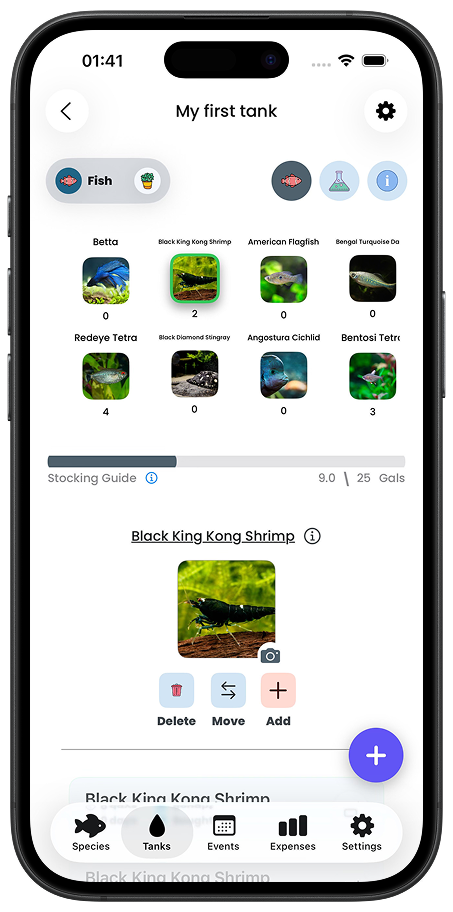
Track your aquarium's health and ensure your Betta coccina is thriving with the Fishi mobile app!
- ✓ Monitor water parameters for optimal Betta coccina health
- ✓ Get reminders for water changes and maintenance
- ✓ Track feeding schedules
- ✓ Log tank observations and fish behavior
- ✓ Manage multiple tanks effortlessly


Loved by over 100,000 fishkeepers