Cochu’s Blue Tetra
Boehlkea fredcochui
(72-82°F)
Care Requirements
💧 Water Parameters
🏠 Tank Setup
🍽️ Diet & Feeding
An opportunistic omnivore that in the wild feeds on small invertebrates, insect larvae, and plant matter, and in aquaria readily accepts quality flake food, micro-pellets, and small frozen or live foods such as daphnia and brine shrimp.
🐟 Community Compatibility
Suitable for an active community tank with other similarly sized, peaceful to mildly boisterous fish that can tolerate its energetic, occasionally nippy behavior.
⚥ Sexual Dimorphism
Males are slimmer and display more intense, vivid blue coloration, while females are fuller-bodied with comparatively subdued hues.
🌍 Origin
South America
About Cochu’s Blue Tetra
Catch a flash of electric blue and you’ll understand why Cochu’s Blue Tetra became a mid-century sensation. This small characin shimmers like polished chrome, its sides firing off cool tones that change with every angle as a school wheels through open water. The effect isn’t paint or pigment so much as physics—layers of guanine crystals in the scales bounce light in a way that creates structural color, the same trick used by butterflies and peacocks.
Boehlkea fredcochui hails from the western Amazon basin, where forest streams and floodplain channels swell and shrink with the seasons. In these tannin-stained waters, sunlight filters through leaves as moving patches, and a tight shoal of blue flashes can dazzle predators long enough for the fish to slip away. In the wild it picks at tiny drifting fare—zooplankton, microcrustaceans, and insect larvae—making the most of the daily plankton pulse that rises into midwater.
The name is a nod to people as much as place. The species epithet “fredcochui” honors Fred Cochu, a pioneering exporter who helped introduce South America’s tetras to aquarists during the global aquarium boom of the mid-20th century. While neon and cardinal tetras stole the limelight, the “blue tetra” carved out a cult following for its metallic sheen and lively group displays, and it still turns up in export lists under trade names that highlight its color.
Taxonomically, it sits within the sprawling characin family (Characidae), a lineage that has kept ichthyologists busy for decades. Cochu’s Blue Tetra is often treated as the sole recognized member of its genus, Boehlkea, a reminder of how dynamic tetra classification can be as new morphological and genetic data are published. That ongoing shuffling doesn’t change the on-the-fins reality: this is a quick, midwater specialist built for life in numbers.
Watch a group and you’ll see constant, low-level choreography—short darts, parallel swims, and sudden turns that ripple through the school. Males typically show more intense blue during displays, while females tend to have rounder bodies when full of roe. Like many small characins, they’re open-water egg scatterers with no parental care; in nature, eggs and fry find refuge among leaf litter and fine roots until they’re large enough to join the glittering ranks in midwater.
A few bonus tidbits for fish nerds: that blue isn’t uniform across the body—different scale angles create a gradient, so the fish can look steel-blue from one side and almost silver from another. They’re also notorious look-alikes, often confused with other “blue” tetras; seasoned observers key in on body shape and the quality of the metallic sheen to tell them apart. Today, Cochu’s Blue Tetra is frequently produced in commercial facilities for the aquarium trade, but its wild lineage still reads like a postcard from the Amazon: fast water, filtered light, and a school that moves as one.
Ready to Add Cochu’s Blue Tetra to Your Tank?
Use our free stocking calculator to see if Cochu’s Blue Tetra fits your aquarium setup!
Try the Stocking CalculatorKeep Your Cochu’s Blue Tetra Happy with Fishi
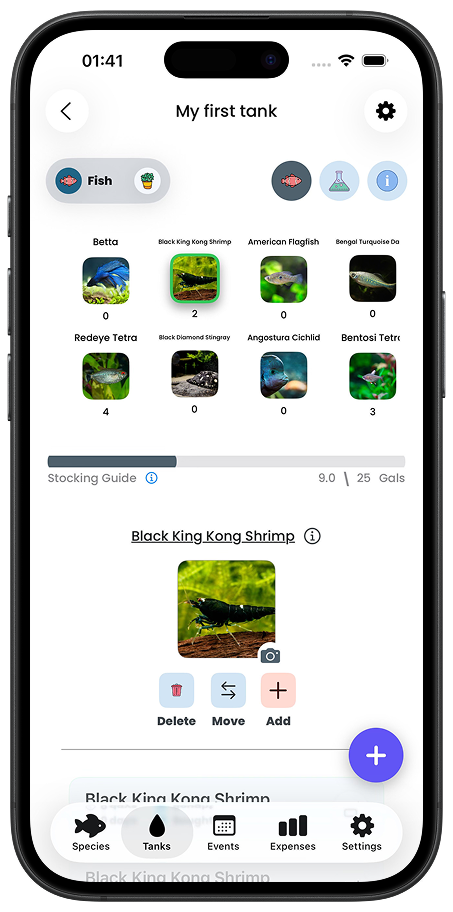
Track your aquarium's health and ensure your Cochu’s Blue Tetra are thriving with the Fishi mobile app!
- ✓ Monitor water parameters for optimal Cochu’s Blue Tetra health
- ✓ Get reminders for water changes and maintenance
- ✓ Track feeding schedules
- ✓ Log tank observations and fish behavior
- ✓ Manage multiple tanks effortlessly


Loved by over 100,000 fishkeepers