Sailfin Tetra
Crenuchus spilurus
(75-82°F)
Care Requirements
💧 Water Parameters
🏠 Tank Setup
🍽️ Diet & Feeding
In the wild it feeds mainly on small aquatic invertebrates and insect larvae, but in aquaria it readily accepts quality flake, micro-pellets, frozen foods like daphnia and bloodworms, and other suitably sized fare.
🐟 Community Compatibility
Suitable for a peaceful community tank with similarly sized, calm fish that thrive in soft, acidic, blackwater conditions.
⚥ Sexual Dimorphism
Males have much taller, sail-shaped dorsal and anal fins, while females’ fins remain shorter and less conspicuous.
🌍 Origin
South America
About Sailfin Tetra
When a male Sailfin Tetra throws up his fins like a living banner, even seasoned fishkeepers stop and stare. Crenuchus spilurus is one of those South American oddities that hides in plain sight: commonly called a “tetra,” yet actually a member of the Crenuchidae, the South American darters. It’s the only species in its genus, a monotypic outlier with a look and lifestyle all its own.
In the wild it ranges across northern South America, particularly in drainages tied to the Amazon and the ancient Guiana Shield. Picture narrow, tea-stained forest creeks with leaf litter piled like dappled carpets, submerged roots stitching the banks together, and light filtered through a canopy that turns noon into permanent dusk. This is leaf-litter country, a world of soft shadows and stillness where movement is measured and sudden.
The fish’s English name writes itself the first time you see a mature male: the dorsal and anal fins rise into tall sails edged in pale, sometimes snow-white filaments, framing a body that can flash velvet chocolate, bottle-green, or metallic bronze depending on mood and light. A dark eye-spot near the base of the tail—spilurus means “spotted tail”—acts as a decoy. Females are more understated, with shorter fins and subtler sheen, but the same poised elegance.
Crenuchus behavior is part hovercraft, part dart. They hang at an angle above the litter, pivoting in tiny bursts to pick off passing morsels, then freeze again like a leaf in the current. Males stake out small display stations, flaring those sails and quivering in place when a female drifts near. Spawning happens in tucked-away spaces—under a broad leaf, within a root tangle, inside a tiny crevice—and the male takes on security detail, guarding the clutch until fry disperse.
Ecologically, the species is a micro-predator tied to the forest’s detritus engine. It sifts the invertebrate life of flooded leaf beds—chironomid larvae, micro-crustaceans, and other tiny drifters—turning the forest’s seasonal leaf fall into fish. When the rains come and the creeks swell into submerged woods, Sailfin Tetras slip into the trees along with a thousand other specialists, riding the flood pulse that powers Amazonian diversity.
For all its beauty, Crenuchus spilurus remains a connoisseur’s fish, overshadowed by brighter, mass-market characins. Those who seek it out discover a species that rewards patience and quiet watching: subtle colors that glow in shade, a courtship dance that unfurls in slow motion, and a lineage that stands slightly apart from the crowd—proof that in blackwater, the best stories are often written in low light.
Ready to Add Sailfin Tetra to Your Tank?
Use our free stocking calculator to see if Sailfin Tetra fits your aquarium setup!
Try the Stocking CalculatorKeep Your Sailfin Tetra Happy with Fishi
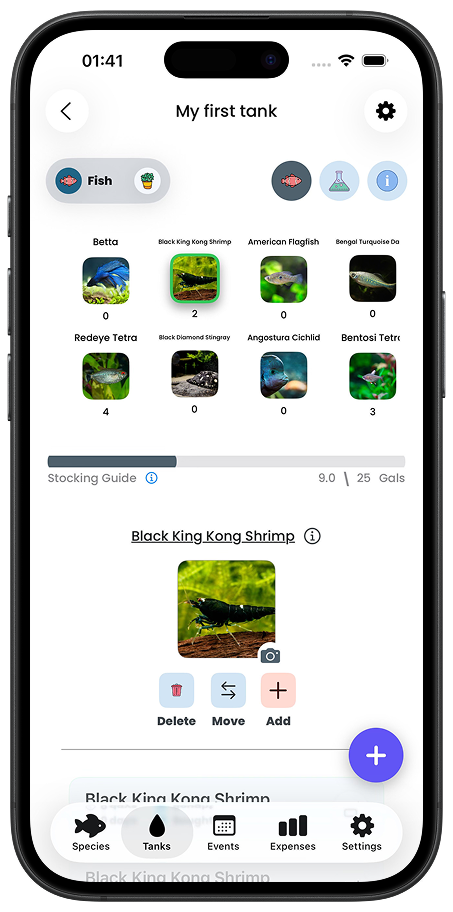
Track your aquarium's health and ensure your Sailfin Tetra are thriving with the Fishi mobile app!
- ✓ Monitor water parameters for optimal Sailfin Tetra health
- ✓ Get reminders for water changes and maintenance
- ✓ Track feeding schedules
- ✓ Log tank observations and fish behavior
- ✓ Manage multiple tanks effortlessly


Loved by over 100,000 fishkeepers