Savage Tetra
Hyphessobrycon savagei
(75-80°F)
Care Requirements
💧 Water Parameters
🏠 Tank Setup
🍽️ Diet & Feeding
In the wild it likely feeds on small invertebrates and other tiny organisms, while in aquaria it accepts quality flake, micro‑pellets, and frozen foods such as daphnia and brine shrimp.
🐟 Community Compatibility
Best kept in groups of its own kind with robust, similarly sized fish, as it may nip or harass smaller or slow-moving tankmates.
⚥ Sexual Dimorphism
No easily discernible differences between genders.
🌍 Origin
South America
About Savage Tetra
With a name like “Savage tetra,” you might expect a riverine brawler—yet Hyphessobrycon savagei is all grace and nuance beneath the surface. This small characin belongs to a famously diverse lineage of tetras, a group that has radiated across tropical America’s streams and floodplains. It spends much of its life cruising midwater in loose shoals, flashing quick signals to its companions and reading the current for the next morsel drifting by.
The scientific name says a lot if you speak a little Greek and Latin. Hyphessobrycon roughly means “the smaller biter,” a nod to the daintier build of these tetras compared with some of their close relatives. The specific epithet savagei almost certainly honors a naturalist named Savage, though the original dedication is not widely documented; either way, the moniker has stuck and given the species one of the hobby’s most memorable common names.
Like many of its congeners, H. savagei is a creature of edges—those quiet margins where currents slacken, roots lace the banks, and leaf litter softens the light. In such places, it sifts opportunity from the water column: tiny crustaceans, insect larvae, micro-worms, and stray zooplankton make up a day’s hunting. An adipose fin and a keen lateral line help it hold station and sense faint vibrations, while schooling keeps many eyes tuned for both food and threats.
Courtship in Hyphessobrycon tends to be a dance of proximity and timing rather than architecture. Pairs or small groups scatter adhesive eggs among fine structures—plants, roots, leaf stems—then move on, leaving development to the quiet chemistry of the water. There’s no parental care; survival is a numbers game played in the gentler backwaters where micro-predators and fry can coexist without constant catastrophe.
Taxonomically, H. savagei sits in a genus that has been under the microscope for years. Hyphessobrycon is large and complicated, and genetic work keeps revealing hidden relationships that don’t always match the old visual groupings based on body shape or spot patterns. Expect to see its family tree redrawn as datasets grow; for now, H. savagei remains a valid, recognizable piece of the tetra puzzle.
Ecologically, species like the Savage tetra stitch together food webs. They convert insect hatches into fish biomass, shuttle nutrients between flooded margins and channels, and in turn become prey for larger fishes and birds. Their abundance and behavior can even hint at the health of small streams that rarely get formal monitoring.
In the human imagination, the “Savage” name is an irony—this is a fish defined not by ferocity but by subtle patterning, quicksilver movement, and social choreography. It’s a reminder that the tropics are built as much from the everyday lives of small schooling fish as from the headline-grabbing giants, and that a quiet shoal in the shade can be one of freshwater’s most compelling sights.
Ready to Add Savage Tetra to Your Tank?
Use our free stocking calculator to see if Savage Tetra fits your aquarium setup!
Try the Stocking CalculatorKeep Your Savage Tetra Happy with Fishi
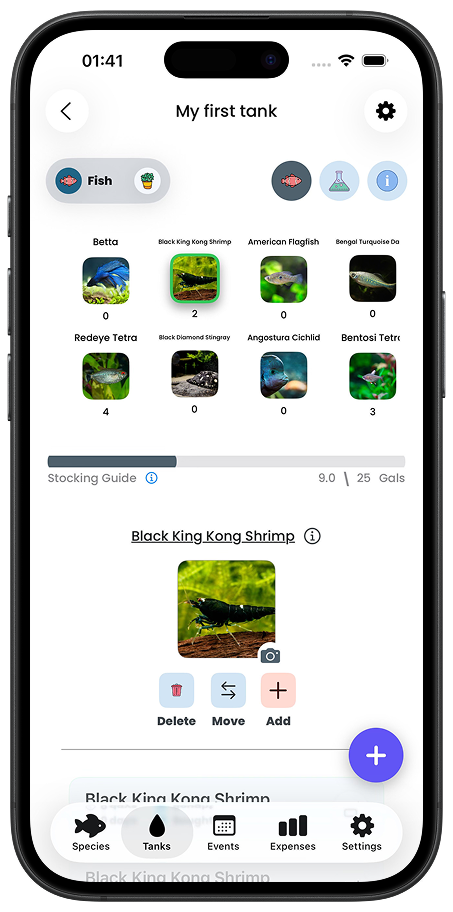
Track your aquarium's health and ensure your Savage Tetra are thriving with the Fishi mobile app!
- ✓ Monitor water parameters for optimal Savage Tetra health
- ✓ Get reminders for water changes and maintenance
- ✓ Track feeding schedules
- ✓ Log tank observations and fish behavior
- ✓ Manage multiple tanks effortlessly


Loved by over 100,000 fishkeepers